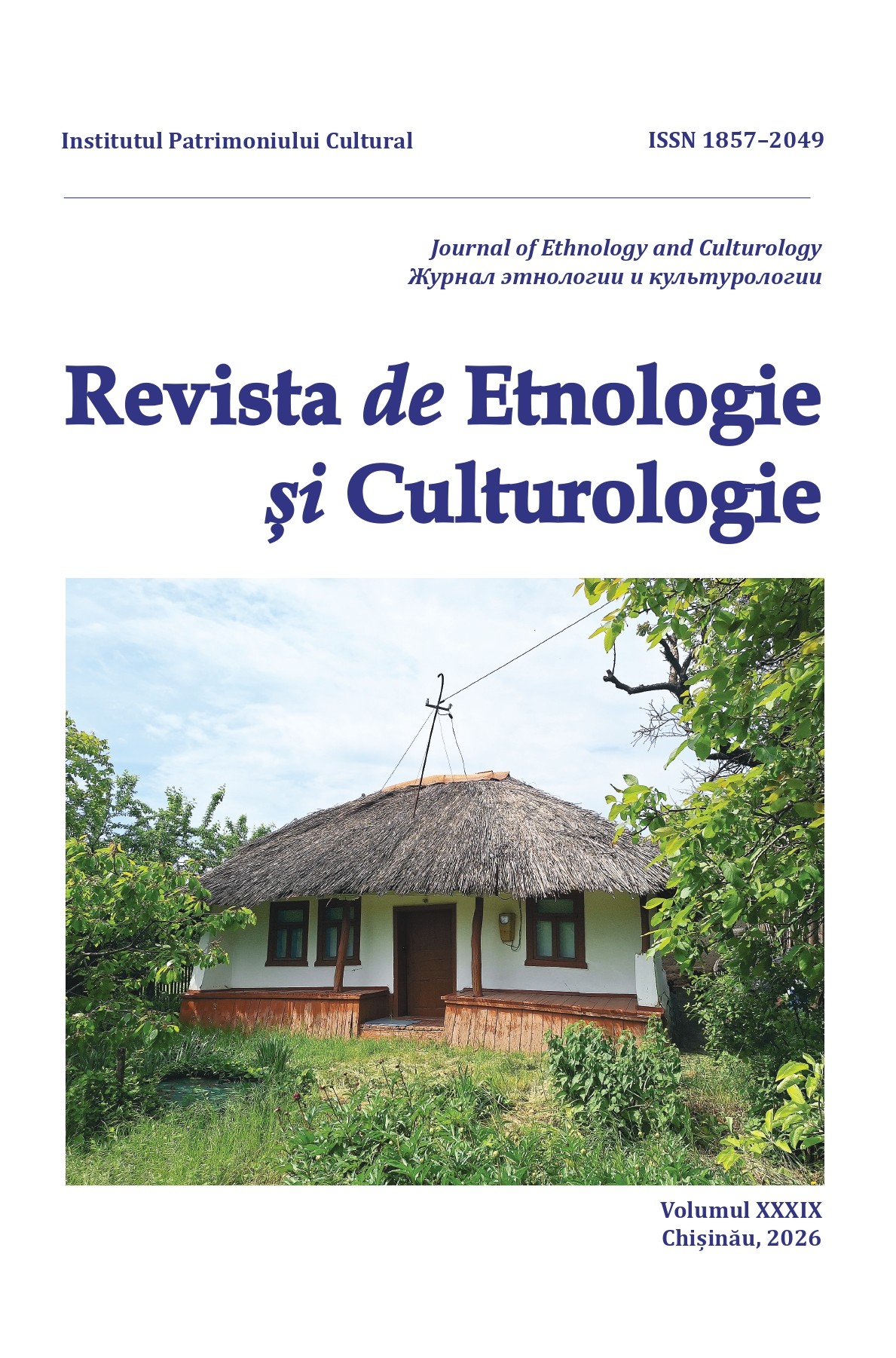
The afterlife of sacred space: casa mare in contemporary rural Moldova (case of Puhoi village)
DOI:
https://doi.org/10.52603/rec.2026.39.06Keywords:
casa mare, consecrated place, ritual, memory, traditionAbstract
Within the framework of field research carried out during ethnographic expeditions to Puhoi village, Ialoveni district in 2026, new data were collected on the traditional practices of the village inhabitants. The focus of our study was a specific space within the traditional rural dwelling – casa mare. Based on the examination of houses, interviews with local residents, and an additional questionnaire survey, an attempt was made to compare the collected data with the characteristics and functions of casa mare known from ethnographic sources. According to the literature, casa mare stood in symbolic opposition to everyday living space: people did not sleep or work there, and meals were taken there only on special festive occasions. The data collected from local residents confirmed that certain aspects of the sacred character of casa mare are still preserved in memory, especially among older people. The questionnaire survey conducted among two age groups of villagers – senior school students and adults – revealed pronounced age differences in the perception of this cultural object. While young people tend to perceive casa mare as an obsolete tradition, a storage space for unused objects, among adults the dominant perception remains its ritual function, despite the fact that in material terms it has almost disappeared from contemporary houses. A tendency is also visible toward the individualization of casa mare as a place of family memory.
References
Assmann J. Cultural Memory and Early Civilization. Cambridge: Cambridge University Press, 2011. https://doi.org/10.1017/CBO9780511996306
Butnaru V. Gheorghe Palade: "Eu țin la folosul națiunii, nu la fala mea". In: In Memoriam Gheorghe Palade (1950-2016). Chișinău: Bons Offices, 2018, 62-65.
Eliade M. The Sacred and the Profane. New York: Harcourt, 1959.
Ghinoiu I. Casa românească: Repere etnologice și arheologice. In: Thraco-Dacica, tom. XII, nr. 1-2, 1991, 167-171.
Ivanova N. Casa mare as a source of authenticity for the urban culture of Chisinau. In: Revista de Etnologie și Culturologie, vol. XXXVI, 2024, 71-78. https://doi.org/10.52603/rec.2024.36.09
Negoiță J. Muzeul satului. București: Editura Meridiane, 1987.
Pârâu S. Lumină și culoare în amenajarea estetică a spațiului țărănesc tradițional de locuit la români. Galați: Editura Fundației Universitare "Dunărea de Jos", 2001.
Postolachi E. Casa mare - funcții şi decor. In: Buletinul Științific al Muzeului Naţional de Etnografie şi Istorie Naturală a Moldovei, vol. 7 (20), 2007, 34-44.
Șofransky Z. Frumosul în arta tradițională. In: Revista de Etnologie și Culturologie, vol. XX, 2016, 8-17.
Thompson J. B. Tradition and Self in a Mediated World. In: Detraditionalization. Critical reflexions on Authority and Identity. Lancaster University, Blackwell Publishers, 1996, 89-108.
Van Gennep A. The Rites of Passage. Chicago: University of Chicago Press, 1960. https://doi.org/10.7208/chicago/9780226027180.001.0001
Байбурин А. К. Жилище в обрядах и представлениях восточных славян. Ленинград: Наука, 1983. / Bajburin A. K. Zhilishche v obryadah i predstavleniyah vostochnyh slavyan. Leningrad: Nauka, 1983.
Дмитрюк В., Пригарин А. Фотографии в сакральном пространстве дома: материалы православных-иннокентьевцев. In: Revista de Etnologie și Culturologie, vol. XVIII, 2015, 21-28. / Dmitryuk V., Prigarin A. Fotografii v sakral'nom prostranstve doma: materialy pravoslavnyh-innokent'evcev. In: Revista de Etnologie și Culturologie, vol. XVIII, 2015, 21-28.
Нестерова Т. Поселения и жилище. In: Молдаване. Москва: Наука, 2010, 265-301. / Nesterova T. Poseleniya i zhilishche. In: Moldavane. Moskva: Nauka, 2010, 265-301.